It should not
be a surprise to anyone that bought my Coinvanish
Vol. 1 manuscript that I have a propensity for high quality (often
expensive) gaff coins.
It should not
be a surprise to anyone that bought my Coinvanish
Vol. 1 manuscript that I have a propensity for high quality (often
expensive) gaff coins.Product Reviews
Reviews written by Dan Watkins
Gaffed Coins
It should not
be a surprise to anyone that bought my Coinvanish
Vol. 1 manuscript that I have a propensity for high quality (often
expensive) gaff coins.
I have owned Johnson Products Expanded shells, C/S coins, Hopping Half, Scotch and Soda, Copper Silver Brass (CSB) Transposition, folding coin, magnetic coin, and flipper coin. Johnson Products is considered by many (including myself) to be the finest mass producer of standard coin gimmicks.
After a while of using Johnson Products coins, I learned of Todd Lassen (now several years ago). Throughout the years I have spent a lot of money on Todd's work replacing the majority of my Johnson Products clad coins with Todd's real silver, and custom coins.
I have four of Todd's shells (3 expanded, 1 unexpanded) – a few C/S coins, some magnetic coins, CSB coin set, folding coin, cut down, re-edged coins, etc. In my mind, Todd sets the standard for custom coin work.
I give you this history so that you, the reader, know that I have a real working knowledge and familiarity with expertly crafted coin gaffs.
The first time I heard of Jamie Schoolcraft was from his involvement with Dean Dill. Jamie manufactures Dean's very expensive Explosion gaff coins, which retail for $1,000 for half dollar coins or $1,800 for silver dollar coins. For those who have not seen the effect; it starts out as a bare handed assembly where coins magically travel from one place to another on a close up pad under the cover of the magician's hands. Then suddenly, two at a time, coins begin to multiply all over the close up mat until sixteen coins are all over the mat!
Over time, Jamie started to make other types of gaffed coins for Dean Dill, which Dean would sell at magic convention dealer rooms and at his Magic Barber Shoppe.
Recently Jamie contacted me to let me know he put up a website and has expanded his business to deal directly with the end user.
After a few emails back and forth, I agreed to buy a selection of Jamie's coins to review here at Coinvanish.com.
I chose a varied sampling of his re-edged walking liberty half dollar coins.
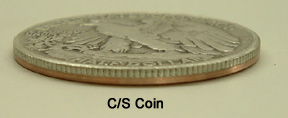
You can see them advertised on his website as "Dean's Ultimate Re-Edged Sets". Jamie advertised them as his personal favorites, so I figured this would be a good place to start. In addition to the advertised set, Jamie also made a copper/silver coin with a walking liberty and a choice of half dollar sized copper pennies – I chose the Australian Penny with a Kangaroo – its nice looking coin with obvious plot potential. The C/S coin was cut down to fit inside the re-edged shell. In addition to this, I also received a standard 3 cut walking liberty folding coin, a cut down un-gimmicked Australian penny, and a walking liberty Swadling flipper coin. All of the coins were sized to fit inside the re-edged shell. Lastly, I also got a half dollar expanded shell, which is more difficult to manufacture than an un-expanded one due to the expanding process. An expanded shell is a good litmus test for a coin gaffer.
So what is the verdict?
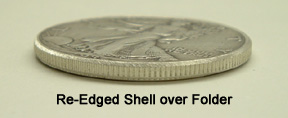
Everything I received was exceptional. The re-edged shell is extremely deceptive. It literally covers the entire edge of a coin it is covering. The re-edging of the shell itself makes it extremely graspable. Let me go on a small tangent here…
If you have never worked with re-edged coins, let me tell you, it felt like another gear in my coin magic transmission when I got a hold of them. The walking liberty coins are what I call semi-soft. They are not so soft that the features of the coin are almost worn away, but there is some level of wear on them so that if you handle the coins with a soft touch, they will not talk. If you handle them a bit stronger, they will jingle and talk when rubbed together. Softer coins make certain techniques when you manipulate stacks of coins quieter and more deceptive. Usually softer coins tend to have more of a worn edge to them, which can make them a little more difficult to classic palm or use edge techniques. Having them re-edged really makes the coins extremely graspable for classic palming or edge grips. As an example – combining the relative ease that soft coins slide against each other, with the grip of the re-edge, a four coin roll down (taught in the foundations section) never has been easier for me.
Multiple classic palming is easier with the re-edge. Because the coins are somewhat soft, it is easy to "soft palm" the coins which means successively adding one coin at a time to create a stack of coins in classic palm. Conversely, because of the re-edge, the coins are very easy to hold and easier to release one at a time from classic palm.
I used to work with more pristine 1964 Kennedy half dollars. As soon as I received these softer re-edged coins and worked with them a bit, I retired my Kennedy sets. I don't plan on going back. The re-edged softer coins are much easier to manipulate. The walking liberty coin is just a hair smaller diameter than a Kennedy, and it is also thinner. A stack of five walking liberty coins is about the size of a stack of four Kennedy's. So it is possible to palm more walking liberties.
End of tangent. Back to the coin gaffs… The shell for Jamie's re-edged set is also re-edged. This is a wonderful idea that Dean Dill suggested to Jamie. It gives the shell the same extra grip that the rest of the re-edged coins have. The benefit of this is immediately realized when palming a shell off of a coin. The shell feels like it effortlessly sticks to the palm, which helps keep the tension out of your hand when palming it. If you recently got Chris Korn's new DVDs and were not able to do the shell palming required for "Coppa Silva" I can tell you from personal experience, this shell gives you a fighting chance. It also makes stealing the shell off in front finger purse palm for bare handed assemblies a breeze.
Switching focus to the expanded shell: it nests perfectly over the re-edged shell, or a regular untouched walking liberty. The expanded shell kept the relief and details of the coin, and maintains a consistent round edge. The coverage is very good, as much as an expanded shell can be. However, the re-edged shell covers better because it is not expanded.
The other item that Jamie advertises as his favorite work is his flipper coin. This coin is a variation of the Swadling coin created by Robert Swadling of England.
Jamie insisted that I get one of these coins for review. I will tell you in advance – I never particularly cared for the flipper coin. To me, it was much easier to use a shell and a coin to show one coin as two or vice-versa. My major issue with the flipper coin is the move needed to open the coin. Pinching a coin and flicking it downward within a routine never looked natural to me. I sold my original Johnson flipper coin years ago.
Under Jamie's unrelenting insistence, I finally caved in, figuring I would not have problems unloading it if I was not happy with it. I am glad he talked me into it. The Schoolcraft flipper coin eliminated my one major gripe with flippers. The way it is designed eliminates the necessity of the flick move to open it. To open this coin, you can literally pick it up by its edges, and the flipper portion will drop open. So… you can simply pick up the coin, and immediately place it on your hand in the open position, without any funky looking moves. It will remain open when laying flat – it will not spring shut. With a slight toss or drop of the hand, it will snap closed.
This feature alone makes the coin deceptive and much more usable. This coin has been the focus of my recent practice sessions. I recently created what I feel to be one of the best coin routines I have ever put together by using this new coin. A prime candidate for Coinvanish Vol. 2 whenever I get that project done!
One last feature of this particular design of the flipper coin is that the rubber band is not in the edge of the flipper part of the coin. Both coin parts that make up the coin are solid looking and re-edged, so it is very deceptive looking from a side view of the open gimmick.
The remaining gaff coins are pretty standard items. The C/S coin has a re-edged silver half and a cut down copper half to match the set. The coin sides are aligned properly and the coin sounds solid when hit with other coins. The folding coin was made with a very fine jewelers' saw and the cuts are almost imperceptible. The cut down copper coin is well… cut down, not too much to say here.
I found Jamie to be a very personable guy and have a quick turn around. One of the other things Jamie did for me was to email me pictures of the coins before he machined them to make sure I liked his selection. He also emailed me pictures of the finished sets before sending them. This was helpful to make sure that all the coins have a similar look. Also for the copper coin, he emailed me a sampling of different copper coins he had in stock. I was able to pick my favorite design.
Here are a couple samples of the final pictures he sent me. Other pictures are available at his website.
|
|
|
|
Based on the work Jamie did for me, I would say that he can safely take his place among the short list of quality custom coin gimmick machinists available to us. I recommend his work.